meet
The Recipe of Stars
6 min · Eve · A story to sit with
Eve
The Recipe of Stars
Eve is reading this story.
Eve is ready
How to say it
Eve can say these names for you.
Tap a name. She will say it slowly.
In 1925 she showed that stars are mostly hydrogen, then helium. The heavier elements that make rocky worlds are only a sprinkle. A famous astronomer told her that could not be right. She wrote it carefully. Later, the sky agreed with her.
If a fingerprint looks faint, is the ingredient rare?
How sure are we?
We know
Stars are made mostly of hydrogen and helium.
We know
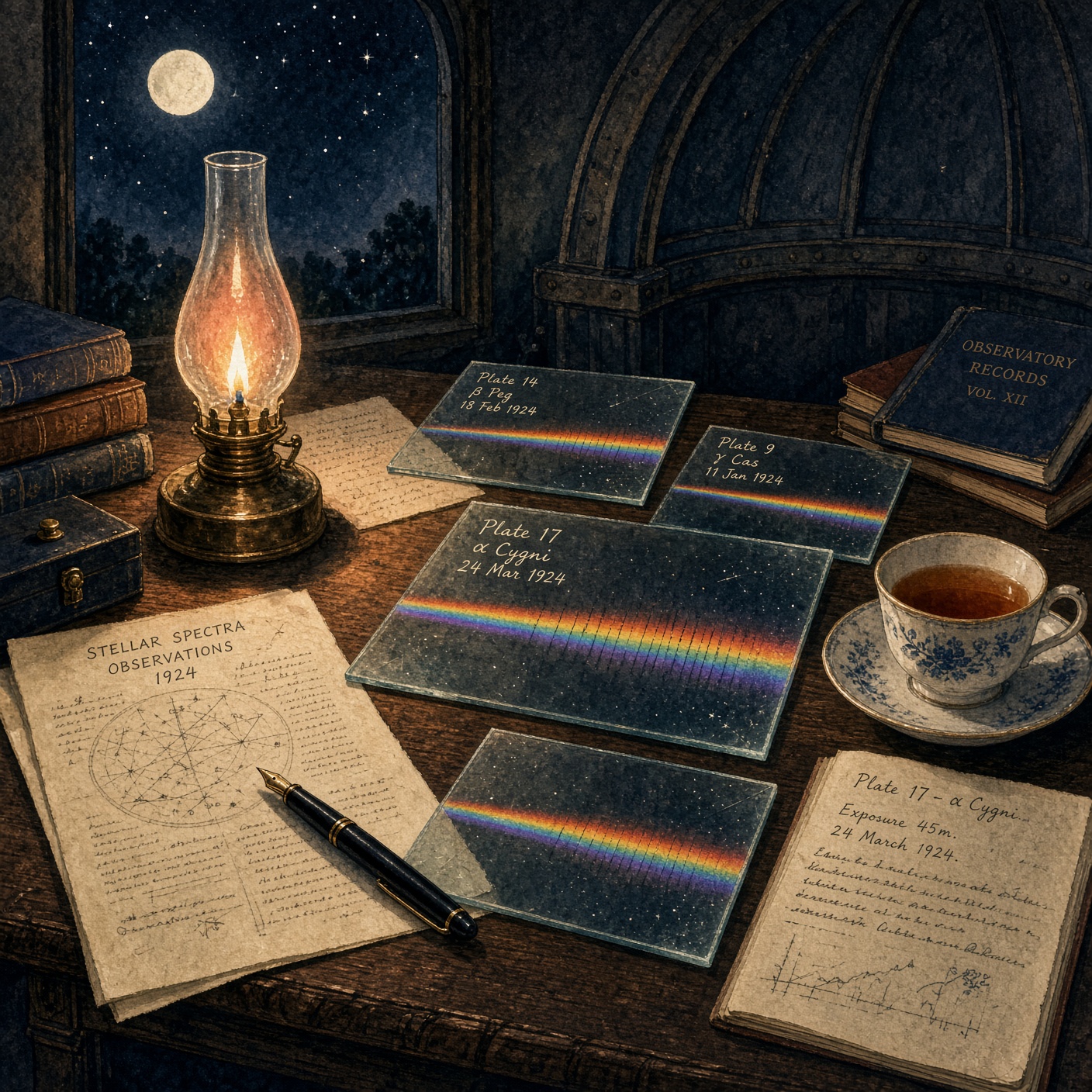
We know this from spectra: each element drinks a different sip of the rainbow.
We're looking
How the very first stars made the first heavier atoms is still an active field.
Try it tonight
- Find a star you can hold with your eyes.
- Notice if it leans gold, or white, or blue. That is heat writing itself. It is not the recipe yet.
- You will not see hydrogen. The plates came later. Color is the first hint the sky will give you.
How we know what a star is made of
The first record is Cecilia H. Payne, Stellar Atmospheres, Harvard Observatory Monograph, 1925. Pass starlight through a spectrograph. Dark lines appear where atoms absorb particular colors. Temperature changes which fingerprints are easy to see. That is why the arithmetic is hard. On page 188 she wrote that the enormous abundance of hydrogen and helium was almost certainly not real. That sentence is caution in the first book, not a later legend. Henry Norris Russell confirmed the hydrogen result in 1929. Otto Struve's praise of the thesis is a later retelling. We do not tell this page as a story about being brave. We tell it as a person, a place, plates, and a number the sky kept.
- Cecilia H. Payne, Stellar Atmospheres, Harvard Observatory Monograph, 1925, p. 188 (first record).
- Harvard Plate Stacks / Center for Astrophysics, Education and Doctoral Thesis.
- Science History Institute, Cecilia Payne-Gaposchkin.
- Henry Norris Russell, On the Composition of the Sun's Atmosphere, Astrophysical Journal 70, 11 (1929).
- American Physical Society, This Month in Physics History (Struve later).
The most brilliant PhD thesis ever written in astronomy.