meet
The Boat That Knew the Way
7 min · Eve · A story to sit with
Eve
The Boat That Knew the Way
Eve is reading this story.
Eve is ready
How to say it
Eve can say these names for you.
Tap a name. She will say it slowly.
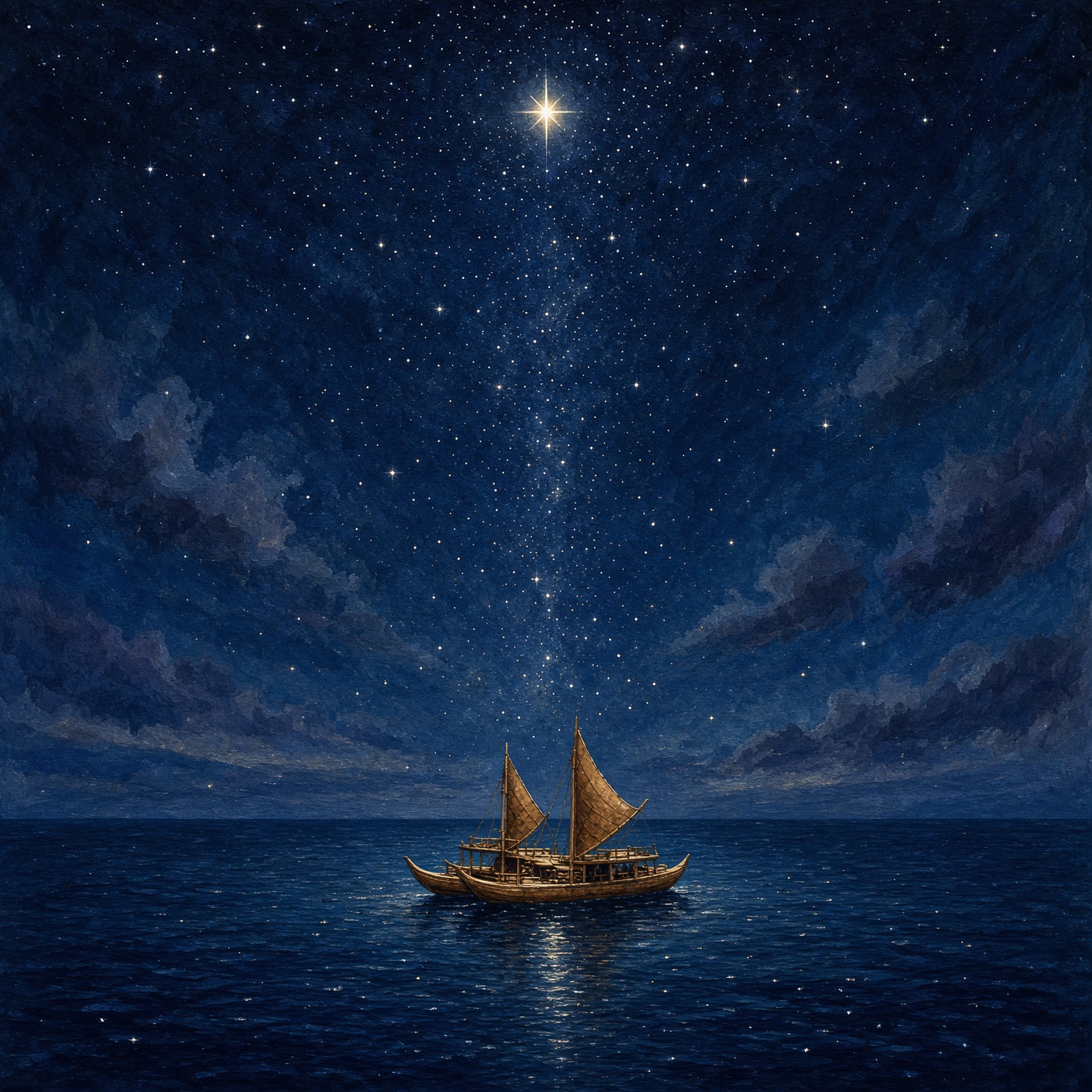
He used a star compass he carried in his mind: where certain stars rise and set, how the swells feel, how birds and clouds speak. This is not the same as drawing Western constellations. It is a Carolinian way of reading the same sky. The canoe arrived. The old knowledge was a science of attention.
How sure are we?
We know
Hōkūleʻa reached Tahiti in 1976 under Mau Piailug's navigation, without modern instruments.
We know
Pacific wayfinding uses stars as a compass rose of rising and setting points, together with ocean swells and wildlife.
We don't know yet
No single story can hold every Pacific tradition. This page tells one voyage, carefully.
Try it tonight
- Find one bright star just as it comes up, if you can, or watch one that is already up.
- Notice the place on the horizon, or the direction from where you stand.
- That rising place is a direction. You do not have to name the star. You do not have to cross an ocean. You only have to notice.
How this page tries to be careful
We do not call every sky tradition a constellation. We do not turn Mau into a mascot. We do not claim Hawaiian and Carolinian systems are the same. The first public record of this voyage is the Polynesian Voyaging Society's own timeline: Honolua Bay, 1 May 1976, to Papeʻete, 4 June 1976. Other people were on the canoe. This page tells the navigator's night, not a crew roll call.
- Polynesian Voyaging Society, 50th anniversary timeline of the 1976 Hawaiʻi to Tahiti voyage.
- PVS history: Mau Piailug of Satawal as navigator; later teaching of Nainoa Thompson.