meet
The Little Points That Moved
6 min · Eve · A story to sit with
Eve
The Little Points That Moved
Eve is reading this story.
Eve is ready
How to say it
Eve can say these names for you.
Tap a name. She will say it slowly.
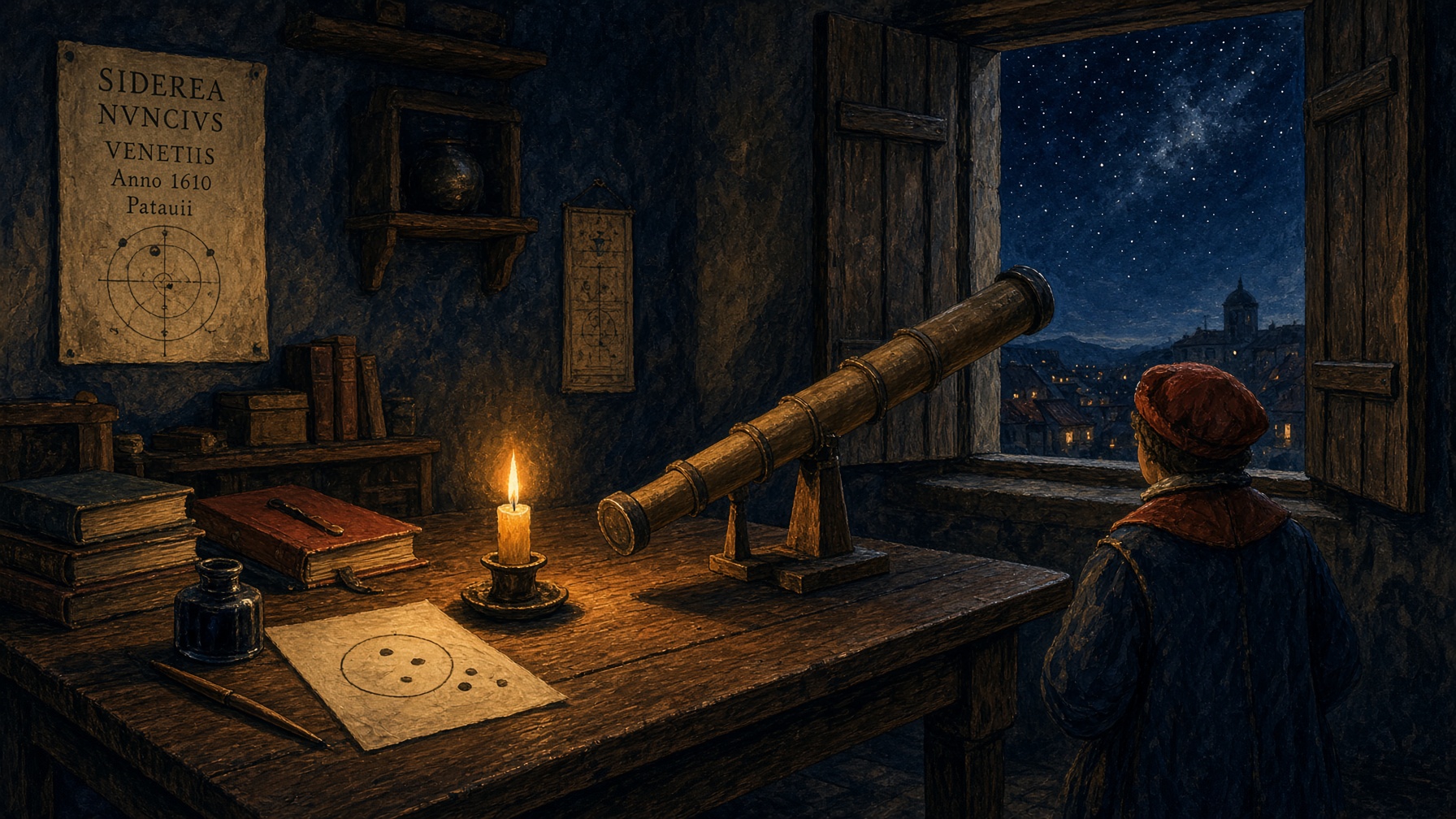
A long time ago, a man named Galileo liked to look at the sky. He made a tube with glass that made faraway lights look closer. One January night he pointed it at Jupiter and saw three little points. He thought they were stars. The next clear night, they had moved. Stars do not do that. On the thirteenth of January he saw four. They were worlds circling Jupiter, the way the Moon circles Earth.
Look again
7 Jan 1610
Three points. He thinks they are stars.
Positions are simplified from Galileo's notebook, not a precise ephemeris.
If something in the sky can go around Jupiter, what else might be true?
How sure are we?
We know
Jupiter has many moons. The four brightest are the ones Galileo saw.
We know
They orbit Jupiter, not Earth. You can watch them change position in a single night.
We're looking
Europa's hidden ocean, and whether anything lives there, is an open search.
Try it tonight
- If Jupiter is up, it will be one of the brightest, steadiest lights in the sky.
- Binoculars held still, braced on a wall, can show the little points.
- Look again an hour later, or tomorrow. If the points have moved, you have seen what Galileo saw.
How we know they are moons
Galileo watched them long enough to see they never left Jupiter, and that their changing places made sense if they circled it. He printed that in 1610. Spacecraft have now visited them. We have photographs, masses, and maps. The discovery began with three dots and a notebook. The four names came four years later.
- Galileo Galilei, Sidereus Nuncius, Venice, March 1610 (first record of the looking).
- Linda Hall Library, Galileo's January 1610 sketches, including the cloudy night of 9 January.
- NASA, 415 Years Ago: Galileo Discovers Jupiter’s Moons.
- Simon Marius, Mundus Iovialis, 1614 (the names Io, Europa, Ganymede, Callisto).