look
The Moon Is Falling
5 min · Eve · Quiet listening
Eve
The Moon Is Falling
Eve is reading this story.
Eve is ready
Imagine throwing a ball. It goes forward, and it also falls. If you could throw it fast enough, the ground would curve away as the ball fell. The ball would keep falling and never land. That path is called an orbit.
Falling, and missing
It keeps missing. That miss is an orbit.
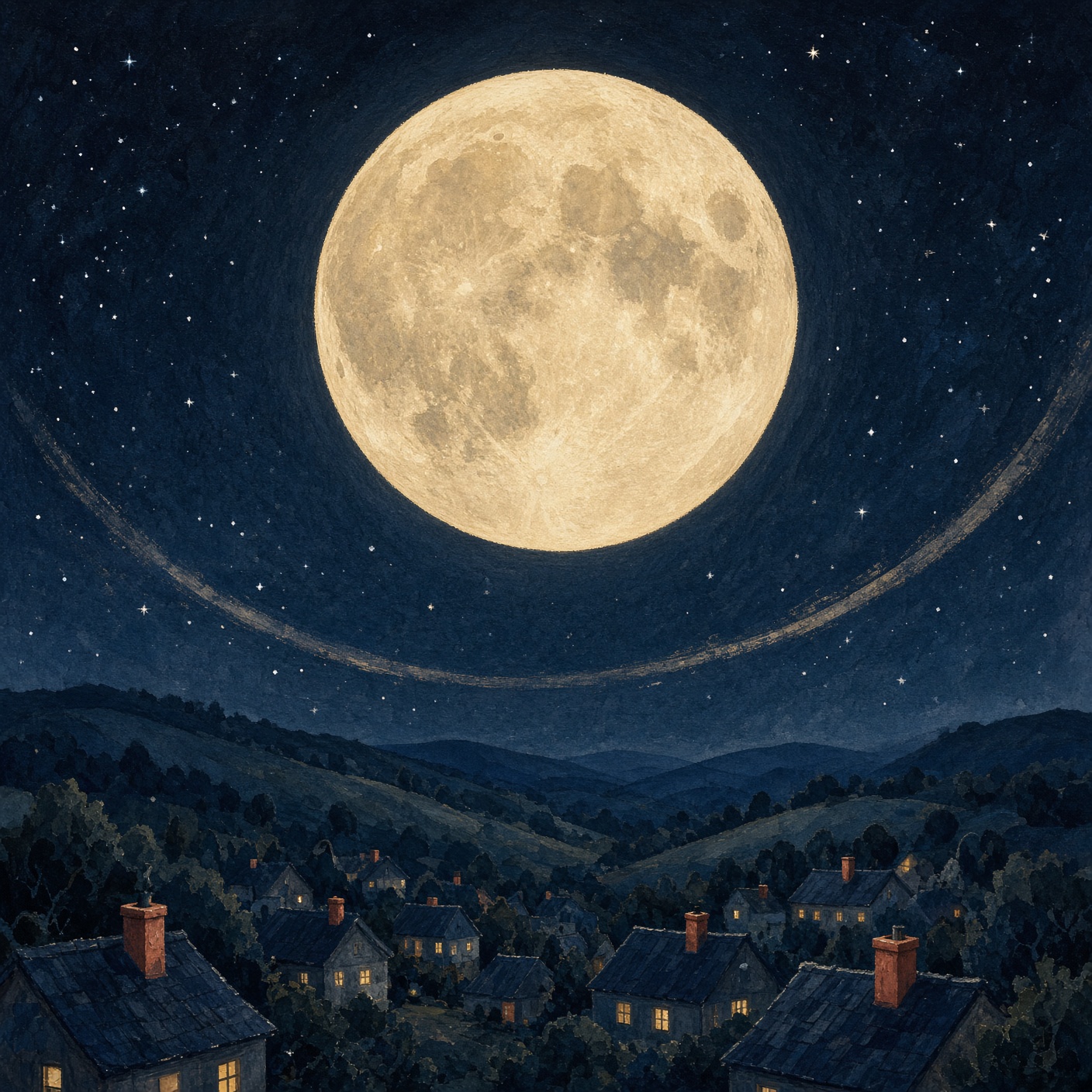
Throw it sideways. Slow, and it falls. Fast enough, it keeps missing. That miss is the Moon.
Then look for the real Moon. This picture is only the miss.
How sure are we?
We know
The Moon orbits Earth because gravity pulls while the Moon moves sideways fast enough to keep missing us.
We know
The Moon is slowly drifting farther away, about 3.8 centimeters a year. We measure this with lasers.
We don't know yet
Exactly how the Moon first formed is still argued. The leading idea is a giant impact long ago.
Try it tonight
- Find the Moon if it is up. Notice its shape tonight. Draw it.
- Look again tomorrow, around the same time. It will have moved and perhaps changed shape.
- You are not watching a sticker on the sky. You are watching a falling world.
A little more
Light from the Moon takes about 1.3 seconds to reach you. When you look at the Moon, you are seeing it as it was a blink ago. The surface you see is sunlit rock and dust. The Moon does not make its own light.
- NASA Moon Fact Sheet
- NASA Scientific Visualization Studio, orbit as free fall