look
The Stars the City Hides
5 min · Eve · Quiet listening
Eve
The Stars the City Hides
Eve is reading this story.
Eve is ready
How to say it
Eve can say these names for you.
Tap a name. She will say it slowly.
In a bright street, you may see only a handful of points. In a dark field, the same sky is crowded. Streetlights, windows, signs. That glow is brighter than the faint stars, so your eyes cannot pick the faint ones out.
If you see only a few stars, did the rest go away?
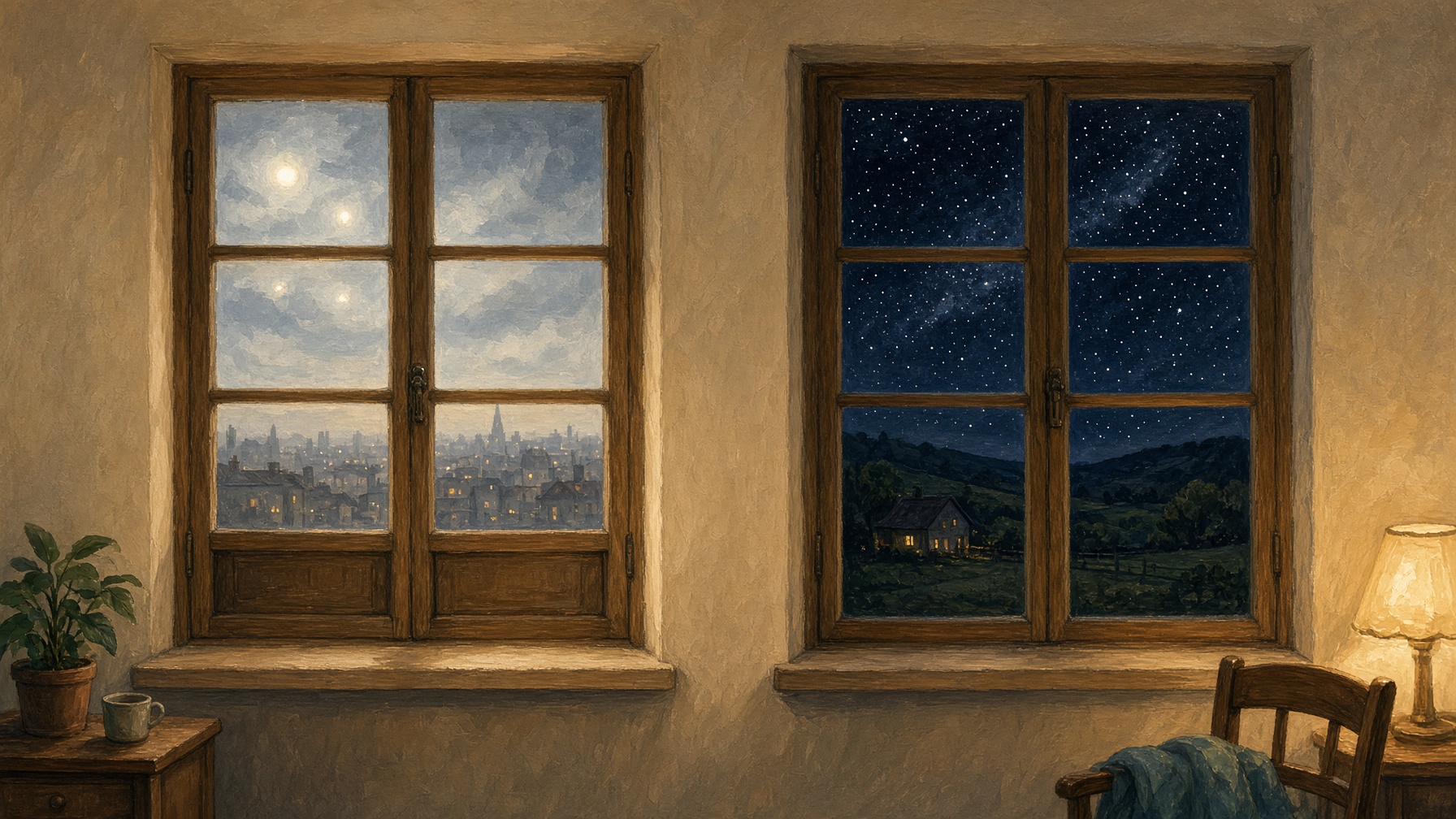
The Sun is about minus twenty-seven. The full Moon is about minus thirteen. Sirius is about minus one and a half. A truly dark sky can show stars down to about magnitude six. A bright city may stop around three. 61 Cygni is about five. Proxima is about eleven. No backyard can see Proxima without help.
How bright is the night here
A town. Some of the faint ones are gone.
The stars did not leave. The air between you and them is lit.
How sure are we?
We know
Fainter stars are hidden by a brighter sky. The stars are still there.
We know
In a very dark place, rested eyes can see stars down to about magnitude 6.
The evidence suggests
Many towns are growing brighter at night. The faint sky is harder to meet than it used to be.
We're looking
People still measure how dark the night is, from the ground and from space.
Try it tonight
- Go outside. If you can, let your eyes rest away from bright lamps for a few minutes.
- Look up. Notice whether the sky looks milky or black.
- Find the brightest point you can. That is enough.
- If you see only a few, they still count. If you see many, they still count. This is not a contest.
Never look straight at the Sun. Night is for this story.
Put it in My SkyA little more, if you want numbers
Five magnitudes are a hundred times in light. A star of magnitude 6 is a hundred times fainter than a star of magnitude 1. Binoculars often reach around magnitude 9. A small telescope goes farther. Hubble and other space telescopes have photographed objects fainter than magnitude 30. None of that is required for tonight. One star will do.
- Pogson, N. (1856), magnitude ratio.
- Sky & Telescope, The Bortle Dark-Sky Scale.
- IAU / standard apparent magnitudes for Sun, Moon, Sirius, Vega.
If you wondered
A Sister in a Little Dipper
Merope is about magnitude 4. Many town skies can still hold her.
Why Stars Wink
The air can hide a star by wobbling it, or by glowing.
The Tiny Shift
The first measured star is faint. City light will often hide it.
The Closest Other Star
The nearest other sun is too faint for eyes alone.